
The Structural Bioinformatics Laboratory at Rensselaer Polytechnic Institute investigates the structural dynamics underlying protein function. Our work utilizes a combination of computational methods and biophysical data to elucidate mechanisms of biological processes.
Research Highlights
Hidden structural states of proteins revealed by conformer selection (2026)
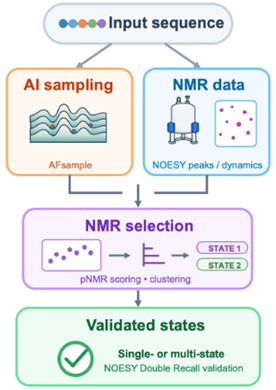
In this study, our lab introduces AI Sampling with NMR Recall selection (AISAR), a framework that uses AI to generate diverse, physically realistic protein conformations and then selects those that best explain experimental NOESY and other NMR data. Unlike conventional approaches that use NMR measurements as structural restraints, AISAR evaluates candidate models to identify multiple conformations in dynamic equilibrium. NOESY Double Recall analysis then provides experimental validation by identifying signals unique to each state, revealing hidden conformations and cryptic binding pockets that may be important for protein function and drug discovery.
Design of intrinsically disordered region binding proteins (July 2025)

In this new Science paper, our collaborators in the Baker lab used AI-guided design to create proteins that bind tightly and specifically to 39 disordered targets, including the opioid peptide dynorphin, cancer-related receptor regions, and prion-like viral sequences. Together with X-ray crystallography, our lab validated the dynorphin binders by NMR, confirming that binding locks the flexible peptide into a defined shape. This modular method can be used to design binding proteins for virtually any disordered protein or peptide target allowing for the ability to now target the “untargetable”.
Rebecca Greene-Cramer was recognized as a Future Leader at the Eastern New York Chapter of the American Chemistry Society. She also received First Place, 3 Minute Thesis (3MT) – Rensselaer Polytechnic Institute in April 2025, and was awarded the Bauer Prize for Best Ph.D. Thesis in Chemistry.

Congratulations to Laura Spaman for Best Oral Presentation at the Chemistry Graduate Student Symposium for her scientific talk titled: “AlphaFold2 and Experimental Biophysics: A Synergistic Approach to Understanding Protein Structure and Behavior,” on Jan 7, 2025.

May 2025

Congratulations to Dr. Rebecca Greene-Cramer for completing a Ph.D. in Chemistry and Chemical Biology, titled “The Pursuit of Broad-Spectrum Antivirals: Leveraging Structural Insights into Viral Proteases”

Statement of Accessibility https://info.rpi.edu/statement-of-accessibility